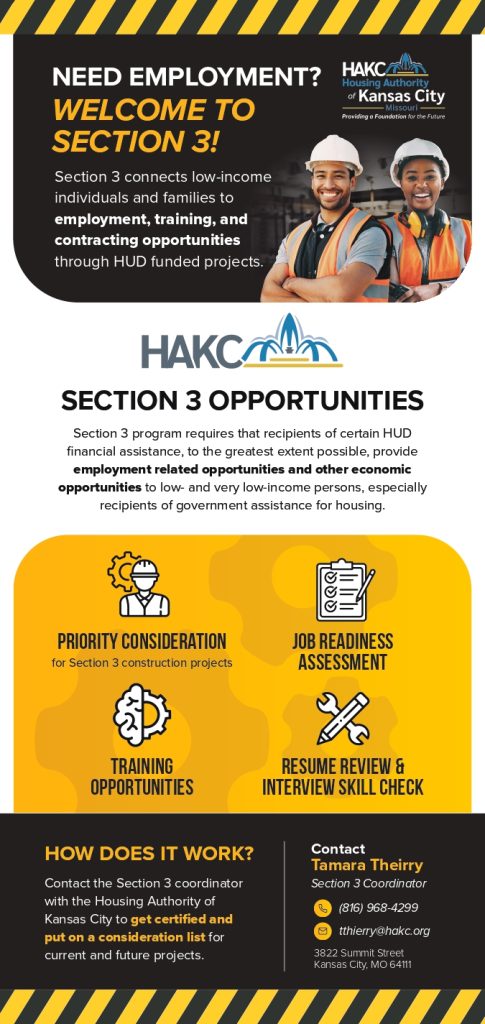
HAKC and all Contractors (construction and/or non-construction) shall provide equal employment opportunity to all employees and applicants for employment without regard to race, color, religion, sex, national origin, disability, veteran’s or marital status, and sexual orientation. All job applicants and existing employees shall be given fair and equal treatment. The implementation of this policy is through the awarding of contracts, to the greatest extent feasible, to create employment and business opportunities for residents and/or businesses to low- and very low-income persons. HAKC and all Contractors shall be proactive in the recruitment, employment, training, and utilization of HAKC residents and other eligible persons within the community for any work made available due to contracts funded by HUD monies.
Changes to Section 3 Effective 2021
Changes to Section 3 adopted by HUD became effective July 1, 2021. The new Section 3 regulations can be found in the Code of Federal Regulations at 24 CFR 75, which replaced 24 CFR 135. The most significant changes under the new rules are that Section 3 compliance will be tracked by labor hours rather than new hires and contracts, and there are no longer Section 3 business contracting goals or requirements. However, HUD and the HAKC encourage the solicitation and utilization of certified Section 3 business concerns to provide contracting opportunities to these firms to assist in meeting Section 3 goals.
This new rule applies to housing rehabilitation, housing construction, and other public construction projects assisted under HUD programs when the total amount of federal assistance to the project from such programs exceeds a threshold of $300,000. Developers of Section 3 projects receiving $300,000 or more from one or a combination of two or more applicable HUD programs (e.g. CDBG, HOME, etc.), will be expected to ensure that to the greatest extent feasible, either directly or through their contractors, employment opportunities at the project are directed to low- and very low-income persons, including seasonal and temporary employment opportunities. The threshold is $150,000 where the assistance is from the Lead Hazard Control and Healthy Homes programs.
To comply with the new rules, new compliance and reporting requirements will be imposed on all Section 3 projects receiving funding from HAKC.
Section 3 covered projects involve the construction or rehabilitation of housing (including reduction of lead-based paint hazards), or other public construction such as: street repair, sewage line repair or installation, updates to building facades, etc.
Section 3 is both race and gender neutral. The preferences provided under this regulation are based on personal income level and location.
For more information about these changes, please review HUD’s FAQs for Section 3, which are available at the following link: https://www.hud.gov/sites/documents/11SECFAQS.PDF.